
THE FEED PREVIEW
If it's happening at SCU, it's here first.

JOIN TO UNLOCK SEASON 1
The $500K AI Film and the One-Man Show
There’s been a lot of talk this past week about Hell Grind, a 95-minute fully AI-generated film that the press called “the first AI movie at Cannes.” It wasn’t technically in competition at Cannes, but it got the headline anyway. It cost about $500,000 to make. Fifteen people worked on it for fourteen days. About $400,000 of that budget went to AI compute alone. To put a usable 25 minutes on screen, the team ran more than 16,000 video generations to land 253 final shots.
That’s the scale of what fully AI-generated cinematic content looks like right now. Big team, big budget, enormous compute costs, brute-force iteration.
I want to be honest with you about what Varsity Nights is.
Varsity Nights started as a hobby. It’s still one person, me. I write the episodes, generate the images, prompt the videos, build the website, run the email list, design the marketing, and answer every comment that comes in. I spend several hundred dollars a month on AI tools and many hours a week on production. There’s no team. There’s no studio. There’s no Higgsfield budget. There’s me, at a desk, building this one frame at a time.
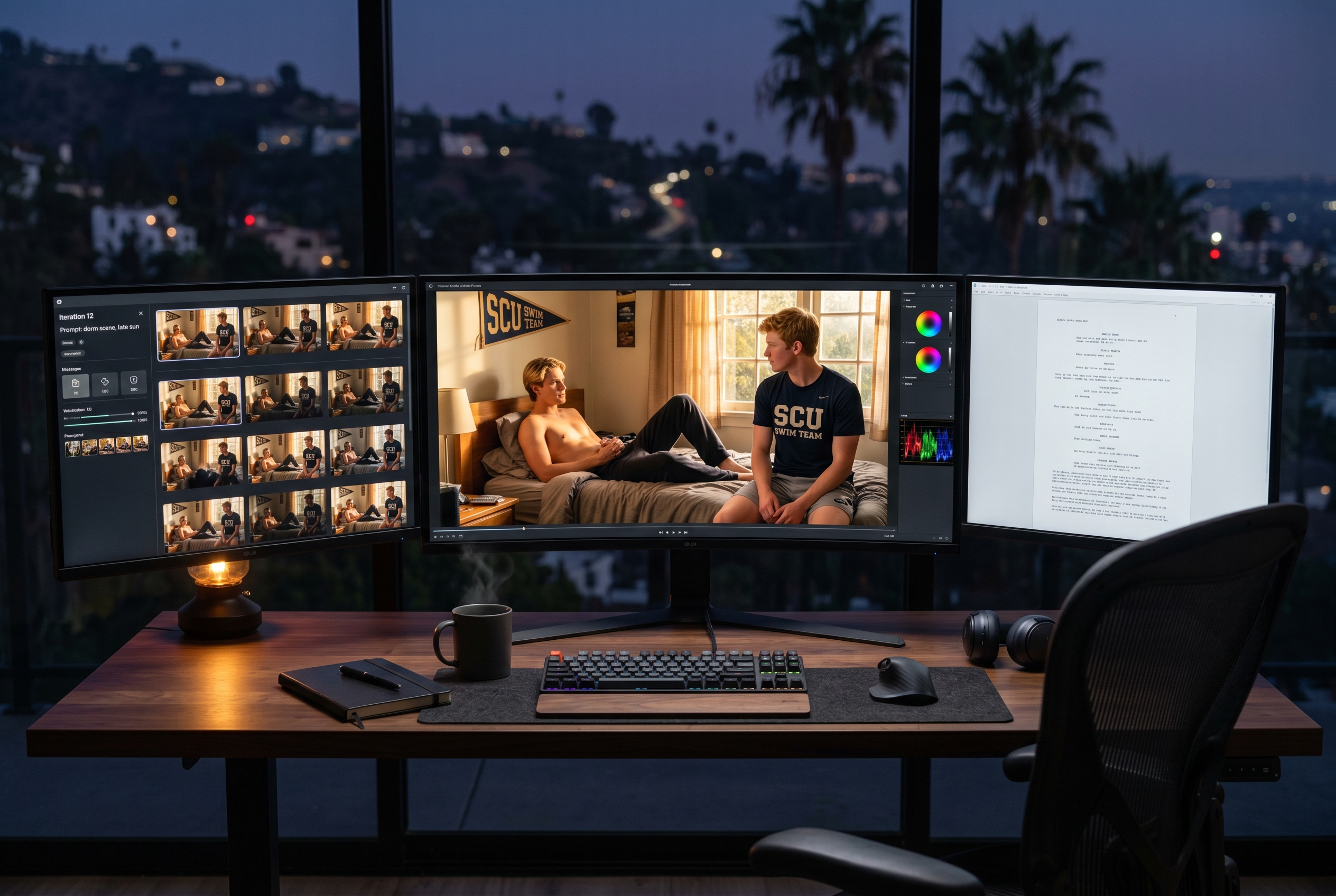
That context shapes the show in ways that aren’t always visible.
When you see a mix of still images, short video clips, narration, and dialogue assembled into an episode — that’s not an accident of style. That’s the format I can sustain at the quality I want to maintain. A fully animated, fully voiced, fully rendered AI episode in the Hell Grind style is technically possible — at fifteen people, fourteen days, and half a million dollars per ninety minutes. What I can do is build a serialized cinematic experience inside the format that actually works for one creator with the current tools. That’s what mixed media is: a deliberate choice to lean into what AI does well right now, instead of forcing it to do what it doesn’t.
Here’s the part of the Hell Grind story I found striking, though. One of its directors, Mikhail Kumarov, said: “The future is one person making a whole film. Like a writer, like a manga artist. Their stories, their fans: the only thing that matters is that a person has light inside; a story they can tell the world.”
That’s the version of AI filmmaking I’m actually trying to build. Not the $500,000 proof-of-concept. The sustainable one. The one where a single person with a story and the right tools can make something that wouldn’t otherwise exist, deliver it every two weeks, and build an audience that shows up for the characters more than the spectacle.
I’m also actively testing newer pipelines as they come out. The ceiling on what’s possible keeps moving. Two-character interaction shots, longer continuous video, more dynamic group scenes — these are all on the horizon, and you’ll see the scope of the show expand as the tools catch up.
But the heart of Varsity Nights isn’t the technology. It’s the characters. It’s Luca and Eli and the room they share and the things they don’t say to each other. It’s Cole watching from across the pool and not knowing what to do about it. It’s a story that’s being told one frame, one scene, one episode at a time, by one person, because that’s the only way a show like this could exist right now.
Thanks for being here. The series exists because subscribers like you decided it was worth supporting. That’s not a small thing, and I don’t take it for granted.
— Arby
Comments
Leave a Reply
You must be logged in to post a comment.

Michal Jensen says:
Hi Arby! I really appreciate all the hard work you’ve put into this amazing and wonderful project—Varsity Nights. Your story and your characters are so real, so authentic, and incredibly sexy. I’m sorry, but I can’t afford to support you financially any more than I already do. Thank you for being here.
Michal
VarsityNights says:
Michal — thank you, that means a lot. Your support at any level is exactly what keeps this show going, and I’m really glad the characters are landing for you. No apologies needed.
— Arby
Chris2025 says:
You are doing a great job.
VarsityNights says:
Thanks Chris! I appreciate you and I’m glad you’re enjoying the content.
cch says:
A great job you do. I appreciate your work very much and hope that this project will run for a long time. Thanks so much. Greetings from Germany.
VarsityNights says:
Thank you so much. I really appreciate your continued support and thoughtful comment. I really enjoy creating this series so I hope I’ll be able to keep it going as well.
4thefellas says:
You’re doing incredible work, Arby. Can’t wait for more!